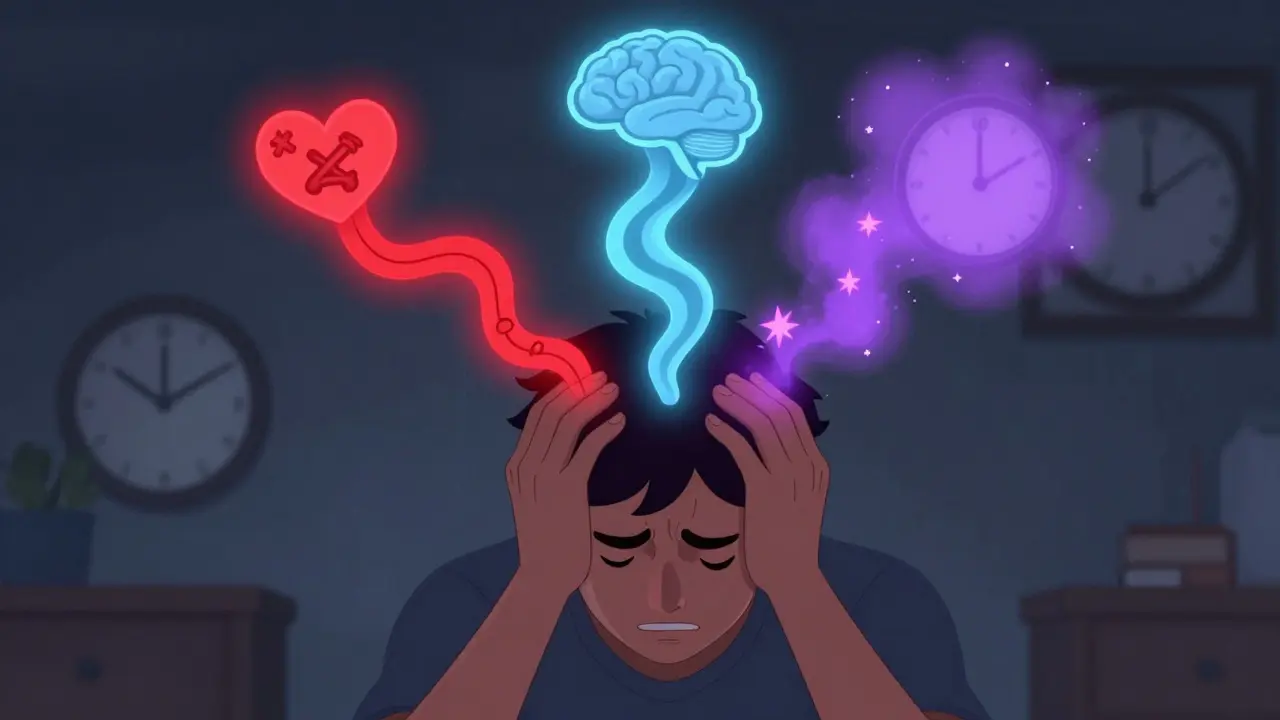
When a migraine hits, you don’t want to wait. You want relief-fast. But not at the cost of feeling worse afterward. For millions, the choice between triptans, gepants, and ditans isn’t just about effectiveness-it’s about safety. And the differences between them are more significant than most people realize.
Triptans: Fast, But Not Without Risk
Triptans were the first real breakthrough in migraine treatment. Sumatriptan, approved in 1991, changed everything. For many, it’s still the gold standard: works in 30 minutes, clears the fog, gets you back on your feet. But it comes with a price.Up to 15% of users feel tingling or flushing. About 8% report a tight, heavy feeling in the chest. That’s not a heart attack-but it’s close enough to scare people. Some stop taking them because of it. One user on Drugs.com wrote: "Experienced severe chest pressure with first dose of Imitrex-never using it again."
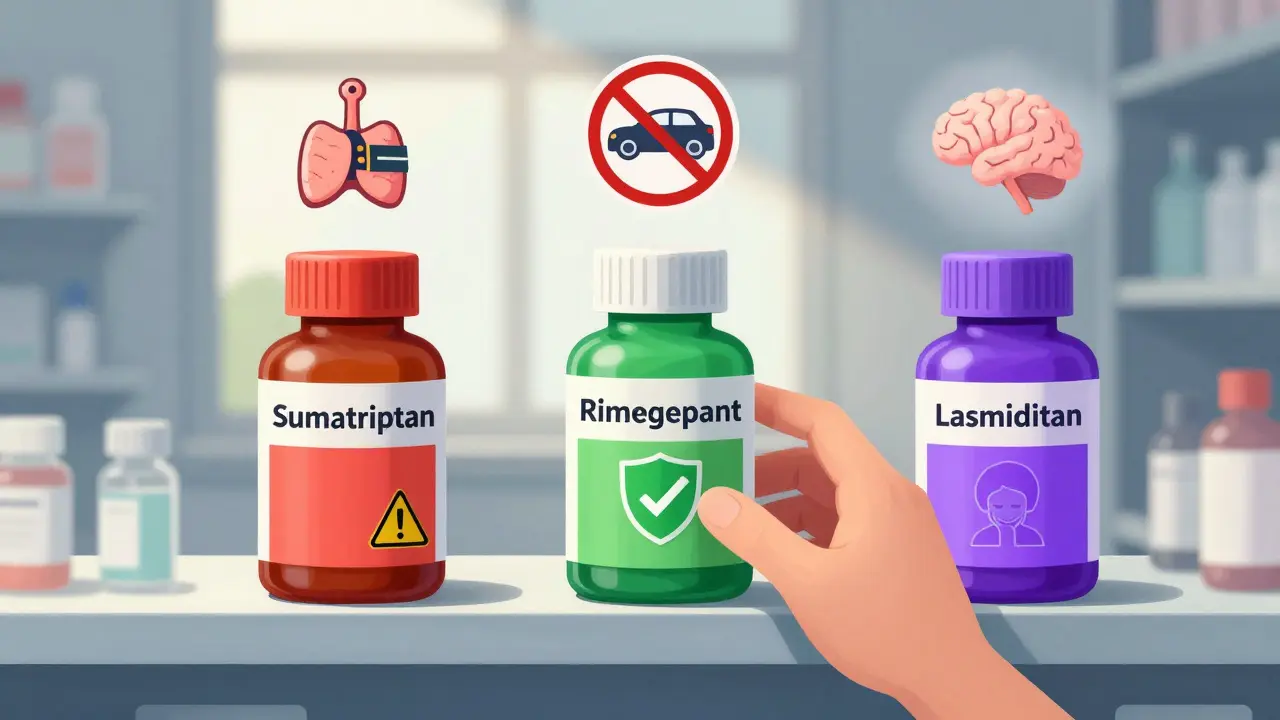
These symptoms come from how triptans work. They activate serotonin receptors that narrow blood vessels in the brain. That’s good for stopping a migraine. But if you have high blood pressure, heart disease, or a history of stroke, that same mechanism can be dangerous. That’s why doctors won’t prescribe triptans to people with cardiovascular risks.
Some triptans are safer than others. Almotriptan and frovatriptan cause fewer side effects. Subcutaneous injections hurt at the site for 40% of users. Nasal sprays leave a bitter taste for a quarter of people. And you can’t use them within 24 hours of dihydroergotamine-combining them raises the risk of dangerous blood vessel narrowing.
Gepants: The Quiet Contender
Gepants are the new kids on the block. Ubrogepant (Ubrelvy) and rimegepant (Nurtec ODT) were approved in late 2019 and early 2020. They work differently: they block CGRP, a protein involved in migraine pain. No blood vessel narrowing. That’s why they’re considered safe for people with heart conditions.The side effects? Mild. Nausea happens in 4-6% of users. Drowsiness affects 2-4%. A rare allergic reaction occurred in 0.1% of rimegepant users. That’s far lower than triptans. On Drugs.com, Nurtec averages 7.1/10. One user said: "No chest pressure like with triptans, just takes longer to work."
But there’s a trade-off. Triptans work faster. Gepants often take 60-90 minutes to kick in. They’re not ideal if you need to get back to work in 30 minutes. But they last longer. Ubrogepant stays in your system for 5-7 hours. Rimegepant lasts 10-12 hours. That means fewer headaches returning after 4 hours.
One big catch: rimegepant can interact with strong CYP3A4 inhibitors like ketoconazole. That can spike drug levels in your blood. If you’re on certain antibiotics or antifungals, talk to your doctor before starting it.
Ditans: Effective, But Too Sedating
Lasmiditan (Reyvow) is the only ditan on the market. It targets a different serotonin receptor-5-HT1F-so it doesn’t constrict blood vessels. That means it’s safe for people with heart issues. But it has a different problem: it hits your brain too hard.In clinical trials, 18.8% of people taking 100mg of lasmiditan felt dizzy. Nearly 10% had tingling in their hands or feet. Almost 8% felt sedated. That’s way higher than placebo. One Reddit user wrote: "Reyvow made me feel drunk without alcohol." Another said: "Felt completely out of it for 6 hours after taking Reyvow-can’t function at work."
The FDA says you can’t drive or operate machinery for at least 8 hours after taking it. That’s not a suggestion-it’s a warning. A 2021 study showed impaired driving ability even 5 hours after dosing. If your job requires focus, or you’re a parent who needs to pick up kids, this isn’t practical.
Other side effects include muscle weakness, vertigo, and cognitive fog. It’s also not recommended if you have a history of seizures-even though there’s no solid proof it causes them, the risk isn’t worth it.
Which One Is Safest?
A 2021 analysis of 64 clinical trials with over 46,000 people found clear patterns:- Ditans had the highest risk of side effects-almost 3 times more than placebo.
- Triptans were in the middle-more side effects than gepants, but still effective.
- Gepants had the lowest risk profile.
When comparing directly, triptans caused more side effects than both ubrogepant and rimegepant. But they worked faster. Gepants were slower, but safer-and better at preventing headaches from coming back.
Here’s what experts say:
- Dr. Elizabeth Loder (Harvard): "I don’t think any of these drugs do much better than triptans overall."
- Dr. Rami Burstein (Harvard): "Lasmiditan’s CNS effects limit its use as a first-line option."
- The Medical Letter: "CGRP antagonists (gepants) are safer for patients with cardiovascular contraindications to triptans."
Market data backs this up. Triptans still make up 62% of prescriptions. But gepants jumped from 2% in 2020 to 28% by late 2023. Ditans? Just 3%. Why? Because people keep choosing safety over speed.
Real-World Experience Matters
Numbers don’t tell the whole story. Real people share their stories online.On Drugs.com:
- Triptans: 6.4/10, 52% positive
- Gepants: 7.1/10, 68% positive
- Ditans: 5.8/10, 37% positive
On Reddit’s r/Migraine, posts about triptan side effects outnumber those about gepants by nearly 2-to-1. Posts about lasmiditan’s dizziness are common-and often include phrases like "I couldn’t think straight," or "I felt like I was drunk."
One pattern stands out: people who switch from triptans to gepants rarely go back. They value the lack of chest tightness and the ability to drive afterward. Those who try ditans often say they’d never use them again unless absolutely necessary.

What Should You Do?
There’s no one-size-fits-all answer. But here’s a simple guide:- If you have heart disease, high blood pressure, or a history of stroke → Choose a gepant. Avoid triptans and ditans.
- If you need fast relief and have no heart issues → Triptans are still your best bet. Try almotriptan or frovatriptan for fewer side effects.
- If you need to stay alert afterward-work, drive, care for kids-avoid ditans. The sedation is too strong.
- If you’re tired of triptans causing chest tightness or nausea → Try rimegepant. It’s the only one approved for both acute treatment and prevention.
Also, remember: some symptoms you think are side effects might actually be part of the migraine. Fatigue, dizziness, weakness-they can be symptoms of the attack itself, not the drug. Your doctor can help you tell the difference.
What’s Next?
New options are coming. Zavegepant, an intranasal gepant, just finished phase 3 trials with a safety profile similar to oral gepants. It could be available soon-offering fast relief without the heart risks.Long-term data is still limited. Only rimegepant has 2 years of safety data. For others, we’re still learning. But the trend is clear: patients are moving away from drugs that make them feel unsafe-even if they work faster.
Today, the best migraine medication isn’t the one that works the fastest. It’s the one you can take without fear.
Are triptans safe if I have high blood pressure?
No. Triptans cause blood vessels to narrow, which can be dangerous if you have high blood pressure, heart disease, or a history of stroke. Doctors avoid prescribing them in these cases. Gepants are safer alternatives because they don’t affect blood vessels.
Can I drive after taking lasmiditan?
No. The FDA requires patients to avoid driving or operating machinery for at least 8 hours after taking lasmiditan. Studies show impaired coordination and drowsiness lasting up to 5 hours. Many users report feeling "drunk" or unable to think clearly. It’s not worth the risk.
Do gepants cause chest tightness like triptans?
No. Gepants work by blocking CGRP, not by constricting blood vessels. Chest tightness is a known side effect of triptans, but it’s extremely rare with gepants. That’s why they’re recommended for people who can’t take triptans due to heart concerns.
Which migraine medication has the fewest side effects?
Gepants have the lowest rate of side effects among the three classes. Nausea affects 4-6% of users, drowsiness 2-4%. Triptans cause dizziness, chest tightness, and fatigue more often. Ditans cause dizziness and sedation in nearly 20% of users.
Is rimegepant better than sumatriptan?
It depends. Sumatriptan works faster-often in 30 minutes. Rimegepant takes longer, around 60-90 minutes. But rimegepant doesn’t cause chest tightness, lasts longer, and can be used for prevention too. If you have heart issues or hate the side effects of triptans, rimegepant is often the better choice.
Can I take gepants and triptans together?
No. There’s no proven benefit, and combining them increases the risk of side effects without improving results. If one doesn’t work, wait and try a different class later-not both at once.
Why are gepants becoming more popular than triptans?
Because patients and doctors are prioritizing safety over speed. Gepants have fewer side effects, no heart risks, and can be used long-term. Even though they’re slower, many people prefer being able to drive, work, and care for their families after taking them.
Do ditans cause seizures?
There’s no strong evidence that ditans cause seizures. But because they affect the central nervous system, doctors avoid prescribing them to people with a history of seizures or those taking other drugs that lower the seizure threshold. It’s a precaution, not a proven risk.
When choosing a migraine treatment, don’t just ask: "Does it work?" Ask: "Can I live with the side effects?" The answer might surprise you.
ninon roy
janvier 14, 2026 AT 12:18Les triptans c’est du passé, personne ne devrait les prendre sauf si t’es prêt à courir le risque d’avoir l’impression qu’un éléphant s’assied sur ta poitrine.
Frédéric Nolet
janvier 16, 2026 AT 11:47J’ai switché de sumatriptan à rimegepant il y a 6 mois et je peux te dire que je ne reviendrai pas. Pas de pression dans la poitrine, pas de peur de faire un malaise. Même si ça prend 45 minutes de plus, je préfère être en vie qu’en forme.
Charles Goyer
janvier 18, 2026 AT 03:48Les gepants sont clairement l’avenir, mais faut pas exagérer non plus. Oui, ils sont plus sûrs, mais ils sont aussi plus chers et moins efficaces pour les migraines sévères. Ce n’est pas une révolution, c’est une amélioration prudente.
Marie Linne von Berg
janvier 19, 2026 AT 02:42Je suis maman de 2 enfants et j’ai arrêté les triptans après une crise où j’ai été incapable de les prendre en charge pendant 2 heures 😅. Rimegepant, c’est ma sauveuse. Je peux même faire la vaisselle après 😊. Merci la science ! 🙌
armand bodag
janvier 20, 2026 AT 15:51On nous vend les gepants comme la solution miracle mais personne ne parle du fait que les études sont financées par les laboratoires qui les produisent. Les triptans ont 30 ans de données, les gepants 4. C’est une manipulation marketing. La médecine moderne est devenue une industrie du bonheur chimique.
jacques ouwerx
janvier 22, 2026 AT 08:59Je trouve ça marrant que tout le monde parle des effets secondaires comme si c’était une course à qui a le moins de symptômes. Moi j’ai eu une migraine pendant 72 heures et j’ai pris tout ce que j’ai pu. Le seul médicament qui m’a sorti de là, c’était un triptan. Pas de doute, il faut choisir en fonction de ce qui marche pour TOI, pas pour les autres.
Claire Macario
janvier 23, 2026 AT 12:32La question n’est pas seulement de savoir quel médicament est le plus sûr, mais quel médicament permet de vivre sa vie sans être en état d’alerte permanente face à la prochaine crise. Les gepants offrent une paix intérieure que les triptans ne peuvent pas donner, même s’ils agissent plus vite. La rapidité est une illusion, la liberté est réelle.
On confond efficacité et qualité de vie. Un médicament qui te rend capable de prendre ton café sans trembler, de regarder tes enfants jouer sans craindre de tomber en catalepsie, c’est ça la véritable guérison.
La médecine moderne a trop longtemps valorisé la vitesse au détriment de la durabilité. Et pourtant, la migraine n’est pas un sprint, c’est un marathon de douleur. Qui veut courir vite et s’effondrer après 100 mètres ?
Les patients ne veulent plus juste être traités, ils veulent être libérés. Et c’est ce que les gepants offrent, même si lentement.
Je ne suis pas contre les triptans. Je suis contre l’idée qu’on doit sacrifier sa sécurité pour une solution rapide. C’est une forme de violence passive, et elle est normalisée.
Le vrai progrès, ce n’est pas un médicament qui fait disparaître la douleur en 20 minutes, c’est un médicament qui te permet de ne plus avoir peur de le prendre.
La prochaine fois que quelqu’un te dit que les gepants sont trop lents, demande-lui combien de fois il a dû arrêter sa journée à cause d’un effet secondaire.
La douleur est temporaire. La peur, elle, dure.
Et la peur, on n’a pas besoin de la traiter. On a besoin de l’éliminer.
Arnaud Bourgogne
janvier 24, 2026 AT 15:29Les gepants, c’est une arme de distraction massive. Tu crois que c’est pour ta santé ? Non. C’est pour te faire payer 300€ par comprimé pendant que les vrais traitements sont cachés par les lobbies pharmaceutiques. Tu penses vraiment que la science ne connaît pas un traitement naturel plus efficace ? Ils veulent que tu restes dépendant. Regarde les chiffres : les triptans coûtent 2€, les gepants 80€. Qui gagne ? Pas toi.
Danielle Bowern
janvier 26, 2026 AT 09:33J’ai testé les trois. Triptans = peur. Ditans = j’ai dormi 6h après. Gepants = je peux encore parler à mon chat. ❤️
James Fitzalan
janvier 27, 2026 AT 08:50Vous parlez tous comme si c’était une question de choix. Moi j’ai pris un triptan hier, j’ai eu une crise cardiaque. J’étais en arrêt maladie pendant 3 semaines. Maintenant je prends rimegepant. Mais je vais vous dire une chose : personne ne vous a dit que les gepants peuvent faire monter la pression artérielle chez certains. J’ai lu un article dans un journal allemand. Les laboratoires cachent ça. Je vous le dis, soyez vigilants. La santé, c’est pas un jeu.